


Key Takeaways
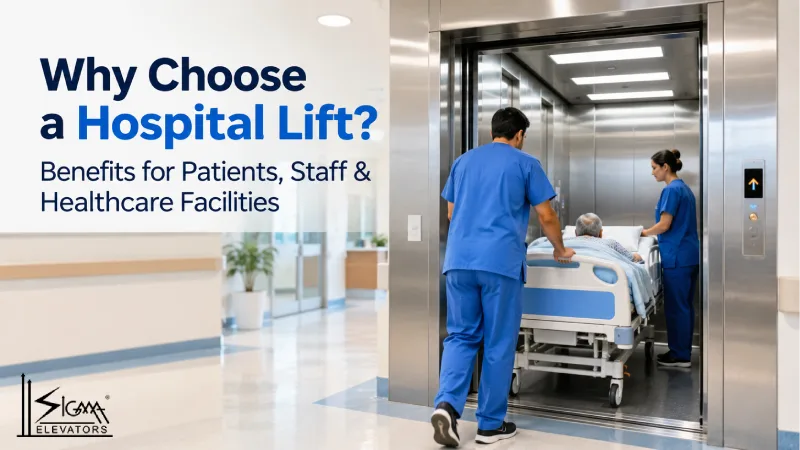
- Hospital lifts provide spacious cabins designed for stretchers and wheelchairs, ensuring comfortable mobility for patients and staff.
- Choosing the best hospital lift manufacturers guarantees access to specialized features tailored for healthcare environments.
- Reliable hospital lifts facilitate efficient movement of medical supplies, patients, and staff across different floors.
- Emergency landing support in hospital lifts ensures patient safety during power outages or emergencies.
- Well-designed hospital elevators can enhance operational workflows, improving overall efficiency in healthcare facilities.
Sigma Elevators is a leading manufacturer of hospital elevators. A hospital lift is built around the practical needs of patients, medical staff, visitors, stretchers, wheelchairs, food, and medical equipment. Choosing the right hospital lift manufacturers can make vertical movement smoother, more comfortable, and better suited to the demanding environment of a hospital or clinic.
What Makes a Hospital Lift Different?
A hospital lift is designed for healthcare environments where movement needs to be handled carefully. Unlike a standard passenger elevator, it needs to accommodate stretchers, wheelchairs, attendants, and other essential hospital users.
The hospital elevator range offered by Sigma Elevators is specially built to accommodate stretchers and wheelchairs. The company’s hospital lifts are intended for hospitals as well as private and public clinics, with stated capacities ranging from 13 to 20 passengers and speeds from 0.25 to 2.00 metres per second.
The main benefit is practical mobility: patients and healthcare teams can move between floors with greater comfort while essential equipment and supplies can be transported through the same vertical route.
Benefits for Patients and Attendants
For patients, every part of movement inside a healthcare facility matters. A well-designed hospital lift provides enough space for stretchers and wheelchairs while supporting smooth travel between floors.
This is particularly useful when a patient needs assistance from medical staff or attendants. Sigma’s hospital elevators are described as being designed for rapid yet comfortable, jerk-free patient transfer.
Patients and attendants can benefit from:
- Spacious cabins suitable for stretchers and wheelchairs
- Smooth and comfortable movement
- Wide entrance options for easier access
- Auxiliary operating controls inside the cabin
- Emergency landing support during power failures
For healthcare projects, working with experienced hospital lift manufacturers helps buyers select a system around actual patient-movement requirements instead of treating the lift as a standard building facility.
How Hospital Lifts Support Medical Staff
Doctors, nurses, technicians, attendants, and other staff often need to move between departments and floors while carrying supplies or assisting patients. A hospital lift supports this movement as part of the facility’s everyday workflow.
A reliable elevator can be particularly useful when staff need to accompany patients on stretchers or wheelchairs. The spacious cabin design offered by Sigma Elevators also supports movement involving medical equipment and other hospital users.
For hospital planners, the right elevator can support several practical needs:
- Stretcher and wheelchair movement
- Staff travel between floors
- Movement of food and medical equipment
- Convenient access for visitors and attendants
- Emergency-oriented elevator functions
This is why healthcare buyers often work closely with Best Hospital Lift Manufacturers when planning new installations or upgrading existing vertical transportation systems.
Benefits for Healthcare Facilities
A hospital elevator is also an important part of the building’s overall functionality. It must fit into the available shaft dimensions while providing enough cabin space for its intended use.
Sigma provides automatic centre-opening and automatic telescopic-door hospital lift configurations. Its published technical specifications include multiple passenger capacities and cabin dimensions, giving project teams options based on building requirements.
The company also lists several healthcare-focused features, including deeper corrosion-free cabins that can be washed or fumigated, calm lighting, auxiliary operating panels, battery-operated emergency landing, emergency non-stop function, and design intended to avoid electromagnetic disturbance to medical equipment.
For facility managers, the value of a hospital lift lies in combining accessibility, operational practicality, and healthcare-specific requirements in one system.
What Should Buyers Check Before Selecting a Hospital Lift?
Every hospital project has different floor layouts, shaft dimensions, traffic patterns, and patient-movement requirements. Buyers should therefore assess the lift against the actual building and application.
A practical checklist includes:
- Cabin space for stretchers and wheelchairs
- Suitable passenger capacity
- Door arrangement and entrance width
- Smooth and accurate floor-leveling performance
- Emergency landing support
- Cabin surfaces suited to hospital use
- Interior operating controls for staff and attendants
- Shaft, pit, and overhead requirements
- Service and maintenance support after installation
These checks can make the selection process easier when comparing hospital lift manufacturers for a healthcare project.
Hospital Lift Capacity and Door Options
Capacity is one of the first technical points that should be reviewed because hospital elevators may need to carry a patient along with attendants and equipment.
Sigma’s published hospital lift specifications include 15-, 20-, and 26-person configurations in both automatic centre-opening and automatic telescopic-door models. The listed entrance widths vary by configuration, while shaft and cabin dimensions are also provided for project planning.
|
Factor |
Why It Matters |
|
Passenger capacity |
Helps accommodate patients, attendants, and staff |
|
Cabin dimensions |
Provides practical space for stretchers and wheelchairs |
|
Door type |
Affects entry and exit movement |
|
Entrance width |
Important for patient and equipment access |
|
Shaft dimensions |
Helps match the lift with the building structure |
|
Emergency features |
Supports operation during power interruptions |
Selecting from the right technical configuration is easier when Best Hospital Lift Manufacturers understand both the elevator and the healthcare application.
Why Choose Us
Sigma Elevators has been engaged in elevator manufacturing, erection, installation, and modernization since 1985. Our hospital elevator range is built around practical healthcare requirements, including stretcher and wheelchair accommodation, spacious cabins, emergency landing support, and smooth operation. We also offer a wider range of elevator solutions for different building applications, allowing us to approach hospital projects with a broader understanding of vertical transportation needs.
Conclusion
A hospital lift is an important part of patient mobility and daily healthcare operations. It supports the movement of patients, doctors, nurses, attendants, visitors, stretchers, wheelchairs, food, and medical equipment between floors. The right system should be selected according to cabin space, capacity, door arrangement, shaft dimensions, emergency functions, and the specific needs of the facility. By choosing experienced hospital lift manufacturers, healthcare organizations can invest in an elevator solution designed for the practical demands of hospitals and clinics. Sigma Elevators provides hospital elevator solutions focused on smooth, comfortable, and healthcare-oriented vertical transportation.
Planning a hospital lift for your healthcare facility? Speak with our team to discuss the right configuration for your project.
Call: +91 7383018998 Or Email: sales@sigmaelevators.in
Frequently Asked Questions
What makes a hospital lift different from a standard elevator?
A hospital lift is specifically designed to meet the needs of healthcare environments, accommodating stretchers, wheelchairs, and medical personnel. Unlike standard passenger elevators, hospital lifts offer spacious cabins and enhanced safety features to support patient movement and transport medical equipment.
What should buyers consider when selecting hospital lift manufacturers?
Buyers should evaluate aspects like cabin space for stretchers, passenger capacity, door arrangements, emergency support features, and shaft dimensions. Assessing these factors ensures that the hospital lift meets the specific requirements of the healthcare facility.
What are the key benefits of using a hospital lift for healthcare facilities?
Hospital lifts facilitate smooth and efficient vertical transportation for patients, staff, and medical equipment, enhancing overall workflow. They are designed with special features like spacious cabins and emergency landing support to ensure safety and comfort during use.
How do hospital lifts support patient mobility?
Hospital lifts are designed to provide ample space, smooth travel, and easy access for patients using stretchers or wheelchairs. These features enhance comfort and ensure efficient movement between different floors within healthcare facilities.
What are the best hospital lift manufacturers known for?
The best hospital lift manufacturers, like Sigma Elevators, are recognized for providing lifts that prioritize safety, spacious design, and practicality for healthcare settings. Their elevators are engineered to accommodate the unique demands of hospitals and clinics, ensuring effective patient and equipment transport.