
Key Takeaways
- Gearless elevator machines offer efficient, smooth operation and reduced maintenance requirements compared to geared systems.
- Understanding gearless elevator technology can help buyers make informed decisions when selecting Gearless Elevator Machine Manufacturers.
- These machines utilize direct drive arrangements, eliminating the need for gearboxes and associated lubrication.
- Key benefits of gearless elevators include energy efficiency, compact design, and high torque responsiveness.
- Gearless elevator systems are versatile and suitable for various applications, including high-rises and commercial buildings.
Sigma Elevators is a leading manufacturer of gearless elevators. When a building requires smooth movement, reliable traction, and efficient operation, the machine driving the elevator plays a central role. Understanding how a gearless elevator machine works helps buyers make better decisions for commercial, industrial, high-rise, and other building applications. For this reason, choosing experienced Gearless Elevator Machine Manufacturers is an important part of planning a dependable vertical transportation system.
What Is a Gearless Elevator Machine?
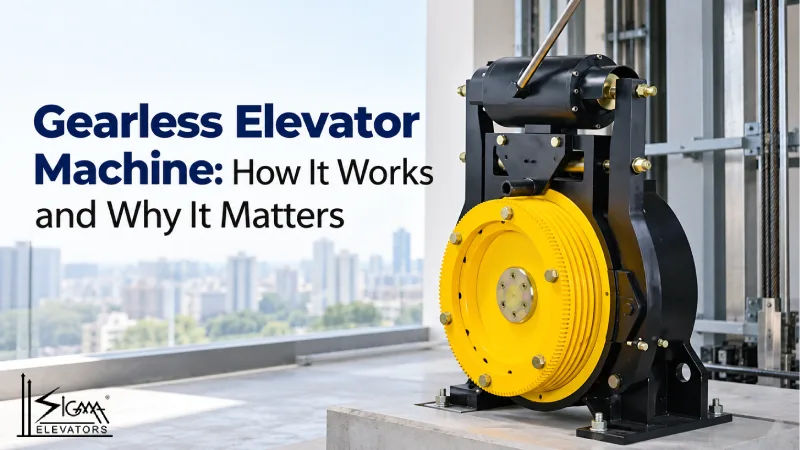
A gearless elevator machine is a traction machine that operates without a gearbox. Instead of transferring motor power through a set of gears, the motor drives the traction sheave directly. The elevator ropes pass over the sheave and are connected to the elevator car and counterweight, allowing the system to move the car between floors.
According to Sigma’s product information, its gearless elevator technology uses permanent magnet synchronous motors and focuses on efficient, stable operation. The absence of a gearbox also removes the need for gearbox oiling or greasing associated with geared systems.
The main difference is simple: direct drive replaces the traditional gearbox with a more compact traction arrangement.
How Does a Gearless Elevator Machine Work?
The working process can be understood through a few connected stages. Each part contributes to controlled and dependable elevator movement.
- The motor generates rotational power: The permanent magnet synchronous motor provides the driving force required for elevator movement.
- The traction sheave rotates directly: In a gearless arrangement, the motor is connected directly to the traction sheave instead of operating through a gearbox.
- The ropes transfer the motion: The rotating sheave moves the elevator ropes, which are connected to the elevator car and counterweight.
- The car moves according to the control system: The elevator control system regulates motor operation, speed, acceleration, deceleration, and stopping.
- The elevator reaches the required floor: Controlled movement allows the car to stop at the required level for passenger entry and exit.
This direct-drive working principle is one of the reasons Gearless Elevator Machine Manufacturers focus strongly on motor design, traction performance, and control technology.
Why Does the Gearless Machine Matter?
The machine is effectively the driving unit of an elevator. Its design influences how the elevator moves, how efficiently it operates, and how much mechanical complexity is involved in the traction system.
A gearless machine matters because it can support smooth operation while reducing the mechanical components found in geared traction systems. Sigma highlights energy efficiency, steady operation, dynamic control, noise reduction, and reduced maintenance requirements among the key features of its gearless elevator solutions.
For building owners, architects, and project teams, this makes machine selection more than a technical decision. The machine should match the building, expected usage, available shaft conditions, and required performance.
Key Benefits of Gearless Elevator Technology
Gearless systems can be useful where performance and efficient operation are important. The main advantages highlighted by Sigma include:
- Energy-efficient and regenerative operation
- Smooth and quiet elevator movement
- Reduced vibration during operation
- Compact machine design
- High torque and responsive motor control
- Lower maintenance requirements
- Flexibility for different architectural requirements
The direct-drive arrangement removes the gearbox from the traction system, which reduces the number of mechanical components involved in power transmission. Sigma also describes its gearless motors as compact and lightweight solutions designed for reliable elevator operation.
Gearless vs Geared Elevator Machines
Both technologies are used for elevator traction, but their machine arrangements are different. Understanding that difference helps buyers evaluate which solution is more suitable for a particular project.
|
Criteria |
Gearless Elevator Machine |
Geared Elevator Machine |
|
Drive arrangement |
Motor directly drives traction sheave |
Motor operates through gearbox |
|
Gearbox |
Not used |
Used |
|
Lubrication related to gearbox |
Not required |
Gearbox lubrication is required |
|
Mechanical design |
More compact direct-drive arrangement |
Includes additional gearbox components |
|
Typical focus |
Efficiency, smooth movement, stable operation |
Traditional geared traction application |
The appropriate option depends on the project requirements rather than one universal choice. For applications where direct drive, efficient operation, and compact machine design are priorities, gearless technology can be an attractive solution.
Where Are Gearless Elevators Used?
Gearless elevators can serve a range of building environments. Sigma lists applications including bungalows, commercial offices, industries, high-rise buildings, hotels, and monuments. Its stated gearless elevator range accommodates 3 to 20 passengers, with a listed speed range of 0.32 to 1.5 metres per second.
This makes the technology relevant across projects with different passenger movement requirements. However, the final elevator configuration should be selected according to building layout, shaft dimensions, load requirements, speed, and intended application.
What Should B2B Buyers Check Before Selecting a Gearless Machine?
A gearless elevator is a long-term equipment decision, so buyers should examine more than the machine name alone. The following checks can make the selection process more practical:
- Passenger or load requirement: Confirm the required capacity for the building.
- Required speed: Match the machine and elevator system with the desired operating speed.
- Shaft dimensions: Review available shaft space, car dimensions, entrance size, pit depth, and overhead requirements.
- Application: Consider whether the elevator will serve a bungalow, office, industrial facility, hotel, high-rise building, or another environment.
- Machine technology: Ask about the motor type, traction arrangement, control system, and key operating features.
- Maintenance needs: Understand the maintenance approach and mechanical components involved in the system.
Sigma provides general shaft, car, entrance, pit, and overhead dimensions on its gearless elevator page, while also noting that technical dimensions may change without notice. Final specifications should therefore be confirmed for the individual project.
How We Approach Gearless Elevator Solutions
At Sigma Elevators, we focus on gearless elevator systems designed around practical building requirements. Our product information covers applications from commercial offices and industries to high-rise buildings and hotels.
Our gearless solutions incorporate permanent magnet synchronous motor technology, direct traction, and features aimed at stable, efficient, and comfortable elevator operation. We also consider factors such as shaft configuration, capacity, speed, and architectural requirements while evaluating an elevator solution.
Working with experienced Gearless Elevator Machine Manufacturers can help project teams select a system that fits both the technical requirements and the intended building application.
Why Choose Us
Sigma Elevators brings a focused approach to gearless elevator solutions, combining direct-drive technology with practical configurations for different building applications. We provide gearless elevators for bungalows, commercial offices, industries, high-rise buildings, hotels, and monuments, with stated capacities and speed options to support different project needs. Our approach is centered on reliable operation, efficient technology, compact design, and solutions aligned with the available building space.
Conclusion
A gearless elevator machine matters because it directly influences the way an elevator generates and transfers traction. By eliminating the gearbox and connecting the motor directly to the traction sheave, the system offers a different approach to elevator movement, with benefits such as efficient operation, smooth travel, reduced mechanical complexity, and lower maintenance requirements. For B2B buyers, the right choice should be based on capacity, speed, shaft dimensions, application, machine technology, and building requirements. Choosing experienced Gearless Elevator Machine Manufacturers can help create a more suitable elevator solution for the project.
Looking for a gearless elevator solution for your commercial, industrial, residential, hotel, or high-rise project? Contact Sigma Elevators to discuss your application, capacity, speed, and space requirements with our team.
Phone: +91 7383018998 or Email: sales@sigmaelevators.in
Frequently Asked Questions
What is a gearless elevator machine and how does it operate?
A gearless elevator machine is a traction system that connects the motor directly to the traction sheave, eliminating the need for a gearbox. This direct drive approach enhances efficiency and reduces maintenance, as it avoids mechanical complexities associated with geared systems.
Why should I choose gearless elevator machine manufacturers for my project?
Selecting experienced gearless elevator machine manufacturers, like Sigma Elevators, ensures that you get a reliable solution tailored to your specific building requirements. Their expertise in gearless technology leads to improved efficiency, lower maintenance needs, and enhanced overall performance.
What are the primary benefits of using a gearless elevator system?
The main advantages of a gearless elevator system include energy efficiency, smooth and quiet operation, reduced vibration, and lower maintenance requirements. Additionally, gearless systems are compact, allowing for flexibility in architectural design.
Where are gearless elevators commonly used?
Gearless elevators are versatile and can be found in various applications, including commercial offices, industrial facilities, high-rise buildings, hotels, and residential complexes. Their adaptability allows them to accommodate different passenger movement requirements.
What factors should I consider when selecting a gearless elevator for my building?
When choosing a gearless elevator, consider passenger capacity, required speed, shaft dimensions, and application type. It’s also essential to evaluate the machine technology, maintenance requirements, and how it fits within your building's architectural constraints.